

A Look at One of Today’s Most Effective Lice Solutions
Finding lice on your child can feel like a crisis, but take a deep breath before you panic. Head lice are one of the most common childhood conditions in the United States, affecting an estimated 6 to 12 million children each year. Having lice says nothing about cleanliness.
The good news is that science has come a long way. Families now have better, more convenient options than what was around a decade ago. One ingredient, ivermectin, has earned real attention from doctors and parents alike. Here is what the research says and what it means for your family.
What Are Head Lice? Quick Facts to Know
Head lice are tiny wingless insects that live on the human scalp and feed on the scalp. An adult louse is roughly the size of a sesame seed, and cannot jump or fly. They spread primarily through direct head-to-head contact, which is why they show up so often among school-age children.
A female louse can lay up to six eggs per day. These eggs, called nits, attach to the hair shaft near the scalp. They hatch in about 10 days. This cycle matters because it explains why some products call for a second round to treat newly hatched eggs while others do not.
What Are Super Lice and Why Do They Matter?
Over the past 20 years, many lice have built up a genetic defense against older ingredients like permethrin and pyrethrins. These resistant lice are often called “super lice.” A study in the Journal of Medical Entomology looked at lice from 138 sites across 48 states and found resistance rates near 98 percent.
A 2023 review published in Heliyon showed that resistance rose from 33 percent before 2004 to 82 percent after 2015. That trend is a big part of why many doctors now point families toward newer choices.
What Is Ivermectin?
Ivermectin is an antiparasitic compound used safely in medicine for decades. Ivermectin works through a different pathway than permethrin or pyrethrins. The genetic change behind super lice resistance has demonstrated little to no effect on ivermectin.
Ivermectin comes from a natural soil organism. Per the FDA, ivermectin works by binding to certain channels in parasites like lice, which causes them to become paralyzed and die.
Here is the key detail. The Medical Letter on Drugs and Therapeutics noted that lice building a defense against ivermectin is rare. That is good news for families dealing with stubborn cases.
What the Research Says About Ivermectin
Two large clinical trials published in the New England Journal of Medicine tested a single use of topical 0.5 percent ivermectin lotion on 781 patients.
Effectiveness was demonstrated in these studies using a single 10-minute application with no nit combing required. The ivermectin lotion does not directly kill eggs on contact, but lice that hatch after initial treatment are not viable and cannot survive. That is why the treatment is FDA- approved with just one application needed.
If resistance is suspected, ivermectin is the over-the-counter lice treatment that the American Academy recommends for children 6 months and older. The CDC says it works for most people in just one use. American Family Physician called topical ivermectin safe, effective, and easy to use.
Ivermectin Lice Treatment Is Now OTC
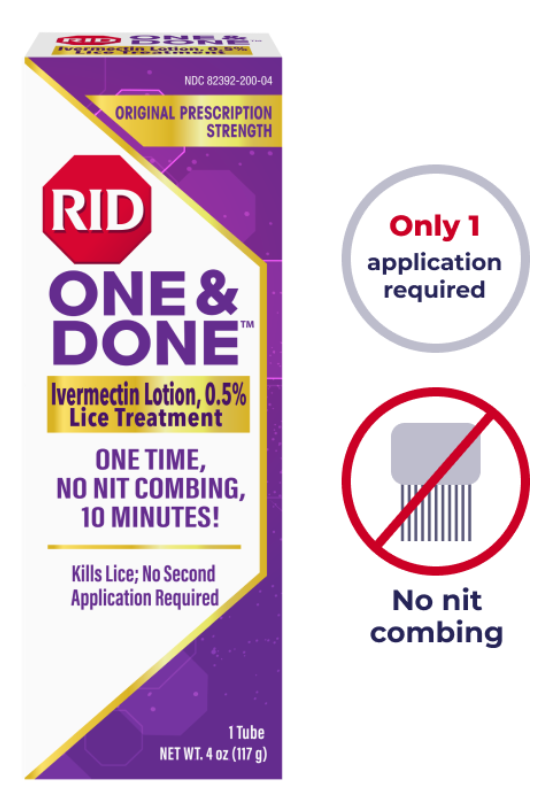
For years, ivermectin lotion was only sold by prescription. A single tube could cost around $280. That put it out of reach for many. Today, things look very different.
Topical ivermectin 0.5 percent lotion is now FDA-approved for over-the-counter sale for ages 6 months and up. RID One & Done uses ivermectin as its active ingredient and delivers the same strength as prior prescription treatments, but without a prescription needed. RID One & Done can be picked up for a fraction of the prescription cost online or in major retailers nationwide.
See our store locator to find RID One & Done near you.
Using it is simple: apply to dry hair, wait 10 minutes, and rinse. No second round of application and no nit combing are needed. For busy families juggling school and work, that ease makes a real difference. With other treatments, nit combing can be a slow, careful task, especially in kids with long or thick, curly hair.
Why Choose Ivermectin Vs. Permethrin 1% Treatment?
Permethrin is an over-the-counter pesticide commonly used to treat head lice. However, the CDC notes that lice in some areas have developed resistance to it.
Early studies from 1984 to 1995 found Nix permethrin lice treatment to be 96% to 100% effective. More recent studies have reported effectiveness rates of only 28% to 55%, even when paired with nit combing.
How it works: Permethrin attacks the nervous system of live lice.
Key details:
-
- Approved for children 2 months and older
- A second treatment may be needed
- Effectiveness has declined as lice resistance has increased
The Modern Approach to Lice Treatment
Dealing with lice can feel overwhelming, but effective, science-backed solutions are available. Ivermectin is an FDA approved lice treatment formula with strong clinical effectiveness that is recommended by the AAP for resistant super lice. It is the only over-the-counter treatment that has been approved by FDA with just one application and no nit combing needed. With affordable over-the-counter access, it’s now easier than ever to choose a prescription strength treatment backed by strong evidence.
Sources
Nolt D, Moore S, Yan AC, Melnick L; American Academy of Pediatrics. Head Lice. Pediatrics. 2022;150(4):e2022059282. publications.aap.org
Pariser DM, Meinking TL, Bell M, Ryan WG. Topical 0.5% Ivermectin Lotion for Head Lice. N Engl J Med. 2012;367:1687–1693. nejm.org
In Brief: OTC Ivermectin for Head Lice. The Medical Letter on Drugs and Therapeutics. 2023;65(1679). secure.medicalletter.org
Ivermectin Lotion 0.5% for Head Lice. Am Fam Physician. 2014;89(12):984–985. aafp.org
FDA Prescribing Information: Ivermectin Lotion, 0.5%. NDA 202736. accessdata.fda.gov
Ivermectin for Parasitic Skin Infections of Lice: A Review. CADTH Rapid Response Reports. 2019. ncbi.nlm.nih.gov
Fronk S et al. Knockdown Resistance in Human Head Lice in the United States. J Med Entomol. 2016;53(3):653–659. academic.oup.com
Abbasi E et al. Resistance of Human Head Lice to Pyrethroid Insecticides: A Meta-Analysis. Heliyon. 2023;9(6):e17219. pmc.ncbi.nlm.nih.gov
Centers for Disease Control and Prevention. Clinical Care of Head Lice. Updated January 31, 2025. cdc.gov
Columbia University Department of Dermatology. How to Get Rid of Head Lice. columbiadoctors.org
This content is for informational and educational purposes only. It is not a substitute for professional medical advice. Always read and follow product label directions. Consult a healthcare provider with any questions about diagnosis or care.